
时间:2016-09-01 09:22:41人气:2382来源: 迪拜新闻网
Chinese authorities have decided to set up seven new free trade zones (FTZs) across the country, bringing the total number to 11 as China looks to replicate the success of previous trials.
The new FTZs will be located in the provinces of Liaoning, Zhejiang, Henan, Hubei, Sichuan and Shaanxi as well as Chongqing Municipality, according to commerce minister Gao Hucheng.
The expansion came nearly three years after the launch of China's first FTZ in Shanghai to test a broad range of economic reforms, including more openness to foreign investment and fewer restrictions on capital flows.
In late 2014, Tianjin, Fujian and Guangdong were approved to set up the second group of FTZs.
With the addition of 7 more FTZs, China is hoping to press ahead with wider reforms, while allowing the regions to tap their unique geographical and industrial advantages for further experiments.
"The decision to expand the FTZs shows authorities' strong resolution in advancing reforms and opening up," Gao told Xinhua in an interview.
He said the FTZs will be launched following necessary procedures, but did not give a timeframe.
According to Gao, Liaoning Province in northeast China will focus on market-oriented reforms to transform the old industrial base into a more competitive area, while coastal Zhejiang is expected to explore trade liberalization of commodities and improve capacity of global allocation of commodities.
Central China's Henan will tap its potential in transportation and logistics, and Hubei will build high-tech bases and facilitate the development of the Yangtze River Economic Belt.
China hopes the FTZs in Chongqing, Sichuan and Shaanxi, all in the country's less developed west, will help open the regions to bring out their economic vitality.
Among the successful trials in the first two groups of FTZs has been the introduction of a "negative list," which specifies investment sectors off-limits to foreign investors and allows industries not on the list to follow the same new investment rules as domestic firms.
The policy has led to a surge in business registrations. In the first half of 2016, a total of 4,923 foreign-funded firms were established in the four FTZs, with investments amounting to 359 billion yuan.
According to a poll conducted by the Development Research Center of the State Council, 82 percent of firms surveyed reported "notable progress" in the business environment, and 95 percent were optimistic about future development.
Encouraged by the results, China is considering expanding the approach nationwide. During its bimonthly session, the National People's Congress (NPC) Standing Committee considered provisions that may allow foreign and Taiwanese investors to start businesses across the country as easily as in the four FTZs.
The Ministry of Commerce said it will work on a nationwide negative list for foreign investment if the top legislature passes the bill.

China advances local hybrid rice seed production overseas
(5990)人喜欢2026-10-18
Embodied AI events to highlight 2026 China Robot Competition in Hangzhou
(6008)人喜欢2026-10-13
China-Laos Railway handles over 80 million passenger trips since opening
(5270)人喜欢2026-10-10
'Meet China' film program brings Chinese cinema, cultural exchanges to Paris
(6023)人喜欢2026-10-05
Two giant pandas set off for 10-year stay at Zoo Atlanta in the U.S.
(6027)人喜欢2026-09-27
Dual holidays plus Canton Fair to drive passenger boom at Guangzhou Baiyun Airport
(6028)人喜欢2026-09-24
China Robot Summit sets standards and global roadmap for embodied AI
(6042)人喜欢2026-09-20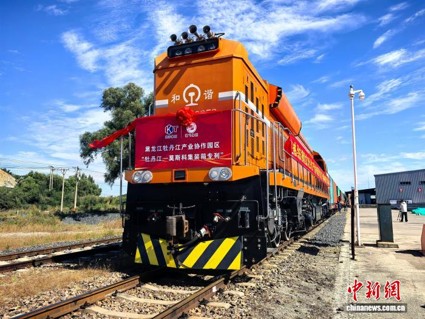
Inaugural Mudanjiang-Moscow freight train service launched
(6049)人喜欢2026-09-16